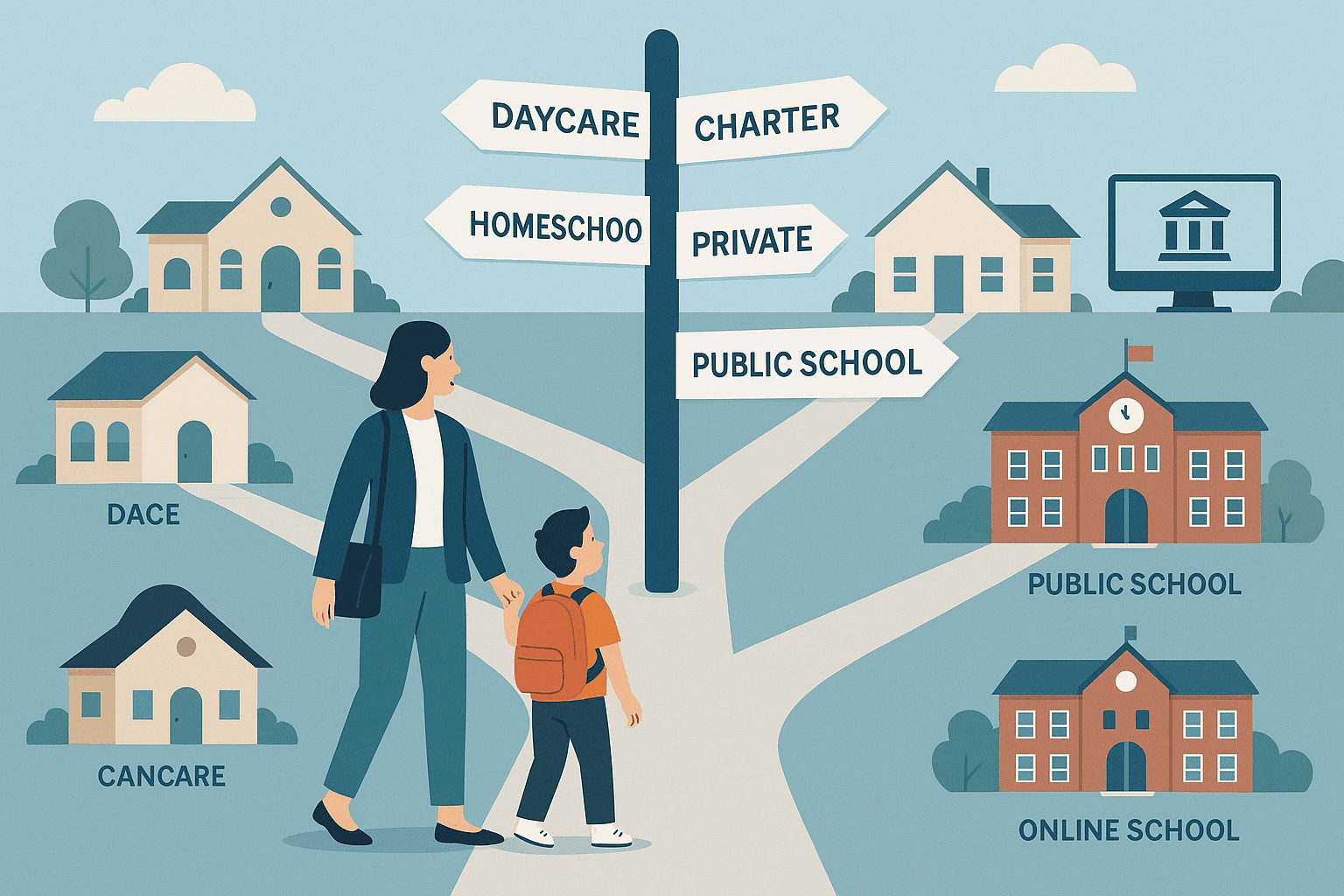
If you are navigating school choice for your child, there are seven main options available in most U.S. states: traditional public school, public charter school, magnet school, private school, homeschooling, microschool/learning pod, and online school. The right fit depends on your child's learning style, your family's values, your state's laws, and your budget. This guide explains what each option actually involves — admission process, cost, academic outcomes, and who each works best for — so you can make an informed decision without the enrollment overwhelm.
How We Evaluated These Options
| Criteria |
Weight |
Why It Matters |
| Academic outcome data |
High |
Standardized test results, college readiness, graduation rates |
| Accessibility |
High |
Availability, waitlists, lottery systems, geographic limits |
| Cost to families |
High |
Tuition, fees, transportation, curriculum materials |
| Flexibility for different learning needs |
Medium |
Special education services, gifted programs, learning style fit |
Data sources: National Center for Education Statistics (NCES), CREDO (Center for Research on Education Outcomes) at Stanford, EdChoice School Choice in America 2025 Report, National Home Education Research Institute (NHERI), U.S. Department of Education.
7 School Choice Options for Families
1. Traditional Public School — Universal Access, Variable Quality
Best for: Families in well-resourced districts or who prioritize in-district social connections
Cost to families: Free (property tax funded)
Admission: Automatic based on home address
Traditional public schools serve 48.6 million K-12 students (NCES 2024) — about 85% of U.S. students. Quality varies enormously by district, with school funding tied to local property taxes creating well-documented resource disparities. Public schools are required to provide services for students with disabilities under IDEA and must accept all students in their attendance zone regardless of ability or need.
Pros
- Free and universally accessible — no application, waitlist, or lottery
- Legally required to provide IEP services and special education support
- Often the most socially diverse environment with established extracurricular programs
Cons
- Quality is heavily correlated with neighborhood wealth — outcomes vary significantly by zip code
- Limited ability to customize curriculum or pace for individual learners
- Class sizes have increased in many districts post-pandemic (average 24:1 in elementary, per NCES)
Who This Is Best For
Families in well-funded districts, students with significant special education needs who require legally mandated services, and families who value broad social diversity and established athletics and arts programs.
2. Public Charter School — More Flexibility, Same Price
Best for: Families seeking a specific educational philosophy without private school costs
Cost to families: Free (publicly funded)
Admission: Application required; many use a lottery system
Charter schools are publicly funded but independently operated under a "charter" granted by a state or local authorizer. They have more curriculum and scheduling flexibility than traditional public schools. A 2023 CREDO study found that urban charter schools on average produce significantly more learning growth than traditional public schools for low-income and minority students, but results are inconsistent — about one-third of charters perform below comparable public schools.
Pros
- Free and open to all students regardless of address
- Greater curricular flexibility — many specialize in STEM, arts, language immersion, or project-based learning
- Often smaller class sizes and stronger community culture
Cons
- Lottery-based admission means you may not get in even if the school is excellent
- Quality is highly variable — research the specific school's performance data, not charters in general
- May have less robust special education infrastructure than district schools
Who This Is Best For
Families whose local public school is underperforming and who want a specialized focus (STEM, arts, dual language) without the cost of private school. Apply early — wait lists are common at high-performing charters.
3. Magnet School — Specialized Public Programs With Selective Admission
Best for: Academically advanced students or those with a strong specific interest area
Cost to families: Free (publicly funded)
Admission: Competitive — application, testing, or portfolio required
Magnet schools are specialized public schools with focused themes (STEM, arts, International Baccalaureate, language immersion) that draw students from beyond a single neighborhood zone. Originally created as voluntary desegregation tools, they remain some of the highest-performing public schools in many urban districts. Admission is competitive — test scores, auditions, or interest statements are typically required.
Pros
- Rigorous specialized curriculum at no cost
- Often among the highest-performing schools in a given district
- Strong peer cohort of similarly motivated students
Cons
- Competitive admission — not accessible to all students
- Transportation may not be provided if you live outside the school's draw zone
- Admission based on testing can disadvantage students from under-resourced backgrounds
Who This Is Best For
Students with a demonstrated passion or aptitude in a specific area (science, performing arts, language) who can handle competitive admission processes and potentially longer commutes.
4. Private School — Maximum Control, Significant Cost
Best for: Families prioritizing specific values, religious education, or elite college preparation
Cost to families: $8,000–$50,000+ per year depending on school and region
Admission: Application-based, with financial aid available at many schools
Private schools are not publicly funded and set their own admission criteria, curriculum, and tuition. Religious schools (Catholic, Jewish day schools, evangelical Christian schools) represent about 68% of private school enrollment. Independent secular schools are the most expensive category, with elite boarding schools averaging $60,000+/year. Financial aid is widely available — NAIS data shows average financial aid per student at independent schools was $21,500 in 2025.
Pros
- Full control over educational philosophy, values alignment, and peer environment
- Typically smaller class sizes and higher per-student resources than public alternatives
- Often stronger college counseling and preparation at the secondary level
Cons
- Significant financial cost — average private school tuition is $12,350/year nationally (NCES 2024)
- Not required to provide IDEA-mandated special education services
- Social homogeneity can be a disadvantage for diverse real-world preparation
Who This Is Best For
Families with specific religious or educational philosophy requirements, families in districts with failing public schools who can afford tuition or qualify for financial aid, and families prioritizing college preparation environments.
5. Homeschooling — Maximum Flexibility, Maximum Parent Involvement
Best for: Families where a parent or guardian has time to teach and the child thrives with individualized pacing
Cost to families: $500–$2,500/year in curriculum materials; higher for enrichment programs
Admission: None — governed by state laws, which vary significantly
An estimated 3.3 million U.S. children are homeschooled (NHERI 2025), a number that doubled following the COVID-19 pandemic. NHRI research shows homeschooled students score 15–30 percentile points above public school peers on standardized assessments on average, though critics note selection bias (families who choose homeschooling tend to be more educationally engaged). State regulations vary from minimal (Texas, Alaska) to moderately structured (Pennsylvania, New York).
Pros
- Complete flexibility in curriculum, schedule, and pace — ideal for gifted, twice-exceptional, or medically complex students
- Strong outcomes in academic testing and college admission data
- Allows for family travel, interest-led learning, and accommodation of unusual schedules
Cons
- Requires significant parental time commitment — effectively a part-time or full-time job for the teaching parent
- Social development requires intentional effort (co-ops, sports leagues, community activities)
- No access to IDEA special education services or district resources
Who This Is Best For
Families with a dedicated teaching parent, children who need customized pacing (advanced learners, children with chronic illness or anxiety), and families with strong philosophical or religious reasons to opt out of traditional schooling.
6. Microschool or Learning Pod — Small Group, Flexible Model
Best for: Families who want homeschool-level flexibility with a social component
Cost to families: $3,000–$15,000/year depending on structure and staffing
Admission: Group formation, often parent-organized
Microschools are small, multi-age learning environments of 5–15 students, often operating outside traditional school classification. Post-pandemic, microschooling has expanded significantly — the Prenda network alone serves 25,000+ students in microschool settings. Staffed by a "guide" rather than a certified teacher, microschools use hybrid models combining self-directed digital curriculum (Khan Academy, Acton Academy curriculum) with in-person project work and social learning.
Pros
- Small group size enables individualized attention with daily peer interaction
- Flexible scheduling and philosophy-alignment with like-minded families
- Growing number of provider networks reducing parent organizational burden
Cons
- Not universally regulated — quality and teacher qualifications vary significantly
- Not eligible for public funding in most states (though ESA voucher programs cover microschool costs in some states)
- Smaller social circle than traditional schools
Who This Is Best For
Families who found homeschooling isolated but found traditional school environments too rigid. Works especially well for entrepreneurial families, world-schoolers, and twice-exceptional learners.
7. Online School — Structured Remote Learning
Best for: Students who perform well independently and families needing schedule flexibility
Cost to families: Free (public online schools) to $5,000+/year (private online programs)
Admission: Varies — public virtual schools accept all in-state students; private programs are selective
Public online schools (like Connections Academy and K12-powered programs) are state-funded, fully accredited, and free to in-state students. Private online schools charge tuition but offer more curricular flexibility. Post-pandemic enrollment has stabilized: NCES reports 3.1% of K-12 students were enrolled primarily in virtual schools in 2024, down from pandemic peaks but significantly above pre-2020 levels. Academic outcomes for online students are mixed — self-motivated students perform well; students needing high structure and social scaffolding often struggle.
Pros
- Maximum scheduling flexibility — ideal for student athletes, performers, or medically complex students
- Public online schools are free and fully accredited with state diploma
- Wide course catalog at secondary level including dual enrollment and AP courses
Cons
- Requires strong self-regulation and parental oversight, especially for elementary-age students
- Social isolation is a documented challenge — requires intentional supplementation
- Screen fatigue and focus challenges are more common than in-person environments
Who This Is Best For
High school students with clear academic goals, student athletes or performers with non-traditional schedules, and families with geographic flexibility (frequent relocation, international travel).
Quick Comparison: School Choice Options
| Option |
Annual Cost |
Admission |
Special Ed Services |
Best For |
| Traditional Public |
Free |
Automatic |
Yes (IDEA) |
Universal access, IEP needs |
| Charter School |
Free |
Lottery |
Varies |
Specialized focus, urban families |
| Magnet School |
Free |
Competitive |
Yes |
Academically motivated students |
| Private School |
$8K–$50K+ |
Application |
Limited |
Values alignment, elite prep |
| Homeschool |
$500–$2.5K |
None |
No |
Flexibility, individualized pacing |
| Microschool |
$3K–$15K |
Group-based |
No |
Small community + flexibility |
| Online School |
Free–$5K+ |
Varies |
Varies |
Schedule flexibility, self-directed |
How We Researched This
This guide draws on the National Center for Education Statistics (NCES) 2024 Digest of Education Statistics, CREDO Stanford 2023 charter school outcome study, EdChoice School Choice in America 2025 Report, National Home Education Research Institute 2025 data, NAIS Independent School Tuition and Financial Aid Report, and U.S. Department of Education Office of Special Education Programs guidance. Last updated: April 2026. We review this guide annually as enrollment and policy data updates.
Frequently Asked Questions
What is school choice?
School choice refers to policies and options that allow families to select a school other than the one assigned by home address. Options include charter schools, magnet schools, private school vouchers, education savings accounts (ESAs), homeschooling, and online schools.
How do I choose the right school for my child?
Start with your child's specific learning needs (pace, learning style, social preferences) and your family's values, then map available options by accessibility and cost. Visit schools in person, talk to current families, and review publicly available test score and graduation data before deciding.
Are charter schools better than public schools?
On average, high-quality urban charter schools outperform comparable public schools for low-income students (CREDO 2023). But charter school quality varies widely — research the specific school's performance, not the category. About one-third of charters underperform their public school peers.
Do homeschooled children perform well academically?
Research consistently shows homeschooled students score above national averages on standardized tests. However, outcomes depend heavily on the quality of instruction and educational resources a family provides. Results are not universal — strong parental commitment is the key variable.
Can I homeschool my child if they have an IEP?
Yes, but homeschooling means your child will likely lose access to IDEA-mandated special education services provided by the district. Some districts offer limited "dual enrollment" services for homeschooled students with disabilities — check your state and district policies. Work with your child's IEP team before transitioning.
What states have the most school choice options?
Arizona, Florida, and Indiana have the most expansive school choice laws, including universal Education Savings Accounts (ESAs) that can be used for private school, microschools, homeschooling, and tutoring. States like California and New York have more restricted choice environments.
How much does private school cost on average?
The national average private school tuition is approximately $12,350/year for K-12 (NCES 2024), ranging from $3,000/year at small religious schools to $60,000+/year at elite boarding schools. Most private schools offer financial aid — the average aid award at NAIS member schools was $21,500 in 2025.
What is an Education Savings Account (ESA)?
An ESA is a state-funded account that parents can use to pay for approved educational expenses outside traditional public school — including private school tuition, homeschool curriculum, tutoring, microschool fees, and online programs. As of 2026, 17 states have some form of ESA or voucher program.
Important Disclosures
This content is for informational purposes only. School availability, admission requirements, costs, and state laws vary significantly by location and change frequently. ParentSimple does not endorse specific schools or educational programs. Consult your local school district and state education department for current enrollment requirements and special education rights.
Last updated: April 2026