Last updated: May 1, 2026 | Reviewed by the ParentSimple Editorial Team
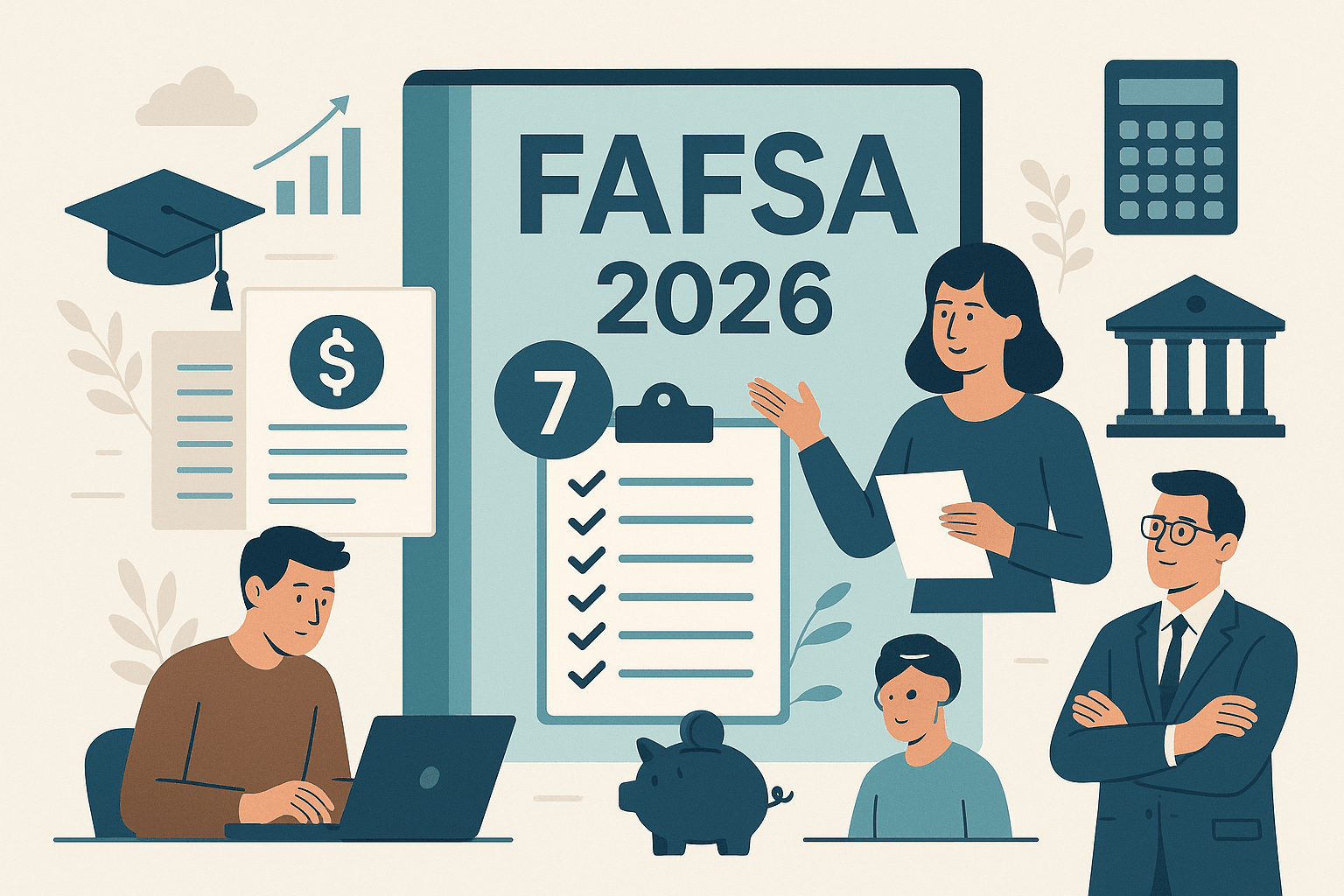
The biggest FAFSA change families need to know for 2026 is the permanent shift from the Expected Family Contribution (EFC) to the Student Aid Index (SAI) — a fundamentally different formula that calculates aid eligibility differently for millions of families. Combined with six other rule changes now fully in effect, the FAFSA families file today works very differently from the one filed five years ago. Here is exactly what changed, what it means for your family's aid package, and how to position yourself before your next filing.
Quick Answers
What changed on the FAFSA for 2026?
The defining change is the permanent replacement of the Expected Family Contribution (EFC) with the Student Aid Index (SAI), a different formula that calculates aid eligibility in a new way. Several related rule changes are now fully in effect, so the form families file today works differently from the one filed five years ago. The sections below break down each change and what it means for your aid package.
Is the FAFSA still using the EFC in 2026?
No. The EFC was retired and the Student Aid Index took its place beginning with the 2024-25 aid year, and the SAI is the standard for all current filings. Unlike the old EFC, the SAI can be a negative number, which signals maximum financial need. The name change matters less than the math change, because the new formula can move a family's eligibility in either direction.
When should families file the 2026 FAFSA?
File as early as you can once the form opens for the aid year you are applying for. Federal aid has a long deadline, but many state grant programs and individual colleges award their own funds on a first-come basis with much earlier cutoffs, so waiting can cost money even when you remain federally eligible. Check the specific deadline for every school on your student's list rather than relying on the federal date.
Change 1: SAI Replaced EFC — and the Math Is Different
The Expected Family Contribution (EFC) is gone. The Student Aid Index (SAI) replaced it starting with the 2024–25 aid year and is now the standard for all current filings.
What changed: The SAI can be a negative number (as low as –$1,500), which signals maximum financial need. The old EFC could only go to zero. Families with very low incomes may now qualify for more Pell Grant aid than they did under EFC calculations.
What didn't change: A lower number still means more aid eligibility. Schools use the SAI to determine your Expected Family Contribution toward the cost of attendance, then build your aid package around the gap.
Who this helps: Families with incomes under $60,000 and low assets generally see better aid outcomes under the SAI formula. Families with moderate-to-high incomes and significant assets may see little change.
Action step: When comparing schools' financial aid offers, make sure you're comparing actual out-of-pocket cost — not sticker price minus grants. Our financial aid maximization guide walks through how to read an award letter correctly.
Change 2: The Form Is Now Dramatically Shorter
The old FAFSA had up to 108 questions. The simplified form has approximately 36. This isn't just a convenience improvement — the shorter form changes what information schools receive and how they calculate need.
What changed: Many situational questions were removed. The form now pulls tax data directly from the IRS via the IRS Direct Data Exchange (DDX), so most families don't manually enter income or tax figures. The system auto-populates this data after you authorize the IRS connection.
What to watch: The IRS data transfer only works if you've already filed your taxes. Families who file extensions may face delays in completing FAFSA, which can push their application past school priority deadlines. File your taxes as early as possible in the year you plan to submit FAFSA.
Action step: Have your FSA ID (Federal Student Aid ID) set up well before you start — both the student and one parent need separate FSA IDs. The IRS authorization step can take several days to process if there's a mismatch.
Change 3: Grandparent-Owned 529 Accounts No Longer Hurt Aid Eligibility
This is one of the most significant rule changes for grandparents who have been saving for college on behalf of their grandchildren.
The old rule: Distributions from grandparent-owned 529 accounts were counted as student income on the FAFSA — reducing aid eligibility by up to 50 cents per dollar withdrawn. A $10,000 grandparent 529 withdrawal could reduce aid by $5,000.
The new rule: Grandparent-owned 529 accounts are not reported on the simplified FAFSA at all. Distributions from grandparent 529s no longer appear as student income. This removes a major strategic obstacle that had caused many grandparents to delay distributions until the student's final year of school.
Action step: If grandparents have been holding 529 distributions to avoid the aid penalty, that constraint is now gone. They can contribute and distribute freely without worrying about FAFSA impact. See our 529 College Savings Plans guide for how grandparent accounts compare to parent-owned plans.
Change 4: The Multi-Child Discount Is Eliminated
Under the old FAFSA formula, having multiple children in college at the same time reduced your EFC for each child — effectively giving families a discount on expected contribution when siblings attended college simultaneously.
The old rule: If two children were in college at the same time, each child's EFC was roughly halved, doubling your family's total aid eligibility.
The new rule: Each child's aid is calculated independently. Having a sibling in college no longer reduces your SAI. Families with two or more children in college simultaneously may see their total expected contribution roughly double compared to the old formula.
Who this hurts: Families who strategically timed their children's college years to overlap — a common financial planning strategy under the old rules — no longer benefit from that overlap. Families with children 3–4 years apart in age who previously assumed overlapping enrollment would help their aid picture need to revise those projections.
Action step: Revisit your college savings goal calculations if you have multiple children and had assumed the multi-child discount would apply. The math has changed significantly for families with overlapping enrollment windows.
Change 5: Small Business and Family Farm Assets Now Count
Under the old FAFSA, small businesses with fewer than 100 employees and family farms were exempt from the assets calculation. That exemption no longer exists for most families.
The new rule: Net value of small businesses and family farms is now included in the FAFSA asset assessment if the family does not live on the farm. Families who live on the farm and it is their primary residence may still qualify for an exemption, but the rules have tightened.
Impact: A family with a small business or farm worth $500,000 in net equity could see their SAI increase significantly, reducing their aid eligibility. The asset protection allowance (a formula that shields a portion of assets based on parent age) still applies, but it may not fully offset the inclusion of business/farm equity for asset-heavy families.
Action step: If your family owns a small business or farm, consult a financial aid advisor before filing. Strategic planning around business structure, valuation, and timing can affect how assets are reported — but must be done legally and well before filing. See our scholarship strategies guide for merit-based aid options that are independent of FAFSA asset calculations.
Change 6: Pell Grant Eligibility Has Expanded
The Pell Grant — federal aid that doesn't need to be repaid — now reaches more families than it did under the old EFC formula.
What changed: The SAI formula's negative floor (–$1,500) and revised income thresholds mean that some families who were previously ineligible for Pell Grants now qualify. Families with incomes up to approximately $80,000 may qualify for at least a partial Pell Grant in 2026, though eligibility depends heavily on family size, assets, and other factors.
Maximum Pell Grant (2025–26 award year): $7,395. Families with the lowest SAI scores receive the maximum; eligibility phases out as SAI increases.
Who this helps most: First-generation college students, larger families with moderate incomes, and families with multiple dependents who were near the eligibility threshold under the old formula.
Action step: Don't assume you don't qualify. File the FAFSA regardless of income — the only way to know your Pell Grant eligibility is to file. Many families incorrectly self-screen out of the application process.
Change 7: Priority Deadlines Are Now More Consequential
FAFSA opening on October 1 each year (for the following academic year) is now firmly established. The window between October 1 and many schools' priority deadlines — typically February 1 through March 15 — is shorter than many families realize.
Why this matters more now: Under the old system, many schools adjusted their aid packages after FAFSA revisions. Under the simplified system with IRS Direct Data Exchange, the data is cleaner and more consistent — which means schools are processing awards faster and priority deadline aid pools are filling earlier.
Missed deadline consequences: Missing a school's priority deadline doesn't disqualify you from federal aid (Pell Grants, federal loans, work-study), but it often means missing institutional grant money — the school's own funds that don't need to be repaid. Institutional grants are finite and distributed on a first-come, first-served basis at many schools.
Action step: Mark October 1 on your calendar as the FAFSA opening date each year. If your student is a junior in high school now, their FAFSA opens October 1, 2026 for the 2027–28 aid year. Have your FSA IDs created, taxes filed early, and submit within the first two weeks of the opening date.
What Has Not Changed
Several core FAFSA elements remain the same:
- The form is still required for all federal financial aid (Pell Grants, subsidized loans, work-study)
- Parent assets are assessed at a maximum rate of 5.64%; student assets at 20%
- Parent-owned 529 accounts are still counted as parent assets (maximum 5.64% assessment)
- Schools still use FAFSA data to build their institutional aid packages
- The aid year covered by a FAFSA is for the upcoming school year — the 2026 FAFSA covers 2026–27 enrollment
FAFSA 2026 Filing Checklist
Before you start your FAFSA:
For a deeper look at how 529 plan assets interact with your FAFSA, see our 529 Plan Tax Benefits guide. And once you understand your aid picture, our scholarship strategies guide covers merit-based funding sources that bypass FAFSA entirely.
Methodology
ParentSimple reviewed these changes using the U.S. Department of Education's official FAFSA Simplification Act implementation documentation, Federal Student Aid (studentaid.gov) program guidelines current as of April 2026, College Board FAFSA analysis, and reporting from the National Association of Student Financial Aid Administrators (NASFAA). Rules described reflect the 2025–26 and 2026–27 award year formulas currently in effect.
Frequently Asked Questions
When does FAFSA open for the 2026–27 school year?
FAFSA for the 2026–27 academic year opened October 1, 2025. If your student is enrolling in fall 2026, your FAFSA should already be filed. For fall 2027 enrollment, FAFSA opens October 1, 2026.
Does the new FAFSA hurt middle-class families?
It depends. Middle-class families with multiple children in college simultaneously are generally worse off (due to losing the multi-child discount). Families with moderate incomes and few assets may see improved Pell Grant eligibility. Families with significant small business or farm assets may see their SAI increase. There is no universal answer — your family's specific situation determines the impact.
Do all colleges use FAFSA for institutional aid?
Most public universities and many private colleges use FAFSA for both federal and institutional aid. Some elite private colleges (primarily those in the CSS Profile system) supplement FAFSA with additional forms. Check each school's financial aid page for their specific requirements.
Can I still correct my FAFSA after submitting?
Yes — you can submit a FAFSA correction at any time. Schools update aid packages based on corrected data, though this may delay processing. Correct immediately if you made an error rather than waiting.
How does divorce affect FAFSA under the new rules?
Under the simplified FAFSA, the parent who provided more financial support in the prior year is the contributing parent — not necessarily the parent the student lives with. This is a change from the old rules (which used the custodial parent). Divorced families should review the updated rules carefully.
Should high-income families still file FAFSA?
Yes. There is no income limit for FAFSA. Federal unsubsidized loans (up to $5,500–$7,500/year) are available to all students who file, regardless of income. Many merit scholarships also require FAFSA on file. Filing costs nothing and takes 30–60 minutes.
Disclaimer: FAFSA rules, Pell Grant amounts, and aid formulas are subject to annual change by the U.S. Department of Education and Congress. Information in this article reflects rules in effect for the 2025–26 and 2026–27 award years as of May 1, 2026. Financial aid outcomes depend on your family's specific financial situation, the schools your student applies to, and available institutional funds. This article is for informational purposes only and does not constitute financial aid advising. Contact your school's financial aid office or a certified financial aid advisor for guidance specific to your situation.
Last updated: May 1, 2026. ParentSimple reviews financial aid guides each academic year.
Reviewed by the ParentSimple Editorial Team.